Dismissal Just Before Retirement: These Options Are Offered by the Pension Fund
Published on 2026-08-28 · by Markus Büchel und Manuel Aeberli
Anyone who receives a termination notice at the age of 58 loses more than just their income. It concerns retirement planning, future pensions, and the crucial question of how to financially secure the years until reaching the AHV (Old Age and Survivors' Insurance).
Currently, many long-standing employees in the financial sector are facing exactly this situation. The legislator has made provisions for this case – and the applicable rules may offer more flexibility than one might initially suspect.
The social plan is more than just a severance payment
In larger restructuring processes, employers and employee representatives typically negotiate a social plan (Art. 335h ff. OR). For older employees, this usually includes three elements:
The temporary assumption of pension fund contributions by the employer.
A one-time contribution to the pension fund to enable early retirement without significant pension reductions.
Or a severance payment for free disposal, intended to compensate for the income gap until reaching the AHV.
The trap lies in the flat-rate solution. What is ideal for one person can be costly for another. The crucial factors are the freely available assets, the tax implications, and personal life planning. Signing the first offer can lead to high costs over the years.
A detail with significant impact. Cash severance payments that exceed the maximum insured salary of CHF 148,200.00 postpone the entitlement to unemployment benefits (Art. 11a AVIG). If the amount is instead paid as a one-time contribution to the pension fund, it is not counted within the regulatory framework (Art. 10b AVIV). Therefore, the form of the severance payment determines when and how much daily allowance will be paid out.
Various courses of action
If the employment relationship ends after the completion of the 58th year of age due to termination by the employer, four options are usually available:
1. Continued insurance without savings contributions
Since 2021, pension funds must offer continued insurance to insured persons aged 58 and older who have been terminated (Art. 47a BVG, introduced with the EL reform). In the basic variant, only the risks of death and disability are insured. While this is inexpensive, it has a disadvantage: the retirement capital continues to accrue interest but no longer grows through additional contributions.
2. Continued insurance with savings contributions
Those who wish can continue to save as before. However, this comes with considerable costs: the insured person bears both the employee and employer contributions alone (Art. 47a Abs. 3 BVG). At least the contributions are tax-deductible.
The two-year rule is important: if continued insurance lasts longer than two years, the retirement benefit can only be drawn as a pension, and a pre-withdrawal for home ownership is excluded (Art. 47a Abs. 6 BVG).
3. Immediate retirement
By law, the pre-withdrawal of retirement benefits is possible from the age of 63 (Art. 13 Abs. 2 BVG). An earlier retirement from age 58 is only possible if the regulations of the pension fund allow it (Art. 13 Abs. 3 BVG in conjunction with Art. 1i Abs. 1 BVV 2). The conversion rate is reduced, and the pension will be lower for life. One-time contributions from the employer from the social plan can mitigate this loss but rarely compensate for it completely.
4. Exit with vested benefits
Those who do not wish to remain insured or draw a pension can transfer their vested benefits to a vested benefits institution. This applies even after age 58, provided the person continues to work or is registered as unemployed (Art. 2 Abs. 1bis FZG). The capital remains intact, and unemployment benefits are not reduced. However, the prospect of receiving a pension from the previous fund is usually lost.
When transferring, splitting is worthwhile. The vested benefits may be divided into a maximum of two different vested benefits institutions (Art. 12 Abs. 1 FZV). Two accounts allow benefits to be drawn in different tax years, thereby breaking the tax progression. However, the decision must be made at the time of transfer. A subsequent division of an already existing account is no longer possible.
Unemployed and retired at the same time. It is possible
Pension fund pensions and unemployment insurance do not exclude each other. Those who receive an old-age pension from the second pillar before the reference age can still register as unemployed. Conditions include, among others, the ability to be placed and the willingness to accept a reasonable job (Art. 8 AVIG). The ongoing old-age benefit is deducted from the daily allowance (Art. 18c AVIG). Since the revision in 2024, it no longer matters for the contribution period whether early retirement was voluntary or involuntary (Art. 12 AVIV).
If the insured person takes a part-time job during unemployment, the salary is considered interim earnings. The unemployment insurance compensates part of the difference to the insured earnings (Art. 24 AVIG). Working is therefore worthwhile even during the receipt of daily allowances.
The case: Termination at 58, retirement with a plan
A client receives a termination notice at the age of 58 effective at the end of the year. The social plan offers her, among other things, continued insurance with or without savings contributions or immediate retirement with an additional employer contribution to the pension fund. She has solid free assets and wants to continue working. She is open to retraining, has already informed herself about corresponding opportunities, and aims for part-time employment in the coming years.
She decides on immediate retirement with a one-time contribution from the employer. After exiting, she registers as unemployed. Her daily allowance is reduced by the ongoing pension fund pension. She is employable, actively applies for new positions, and is working on retraining.
This choice comes at a cost: the pension remains lower for life. Until the age of 65, she must rely on her own assets in addition to the pension and daily allowances. This requires budget discipline.
We calculated the mentioned scenario using the financial advisory tool "Omnium" from G+D Netcetera, formerly Braingroup.
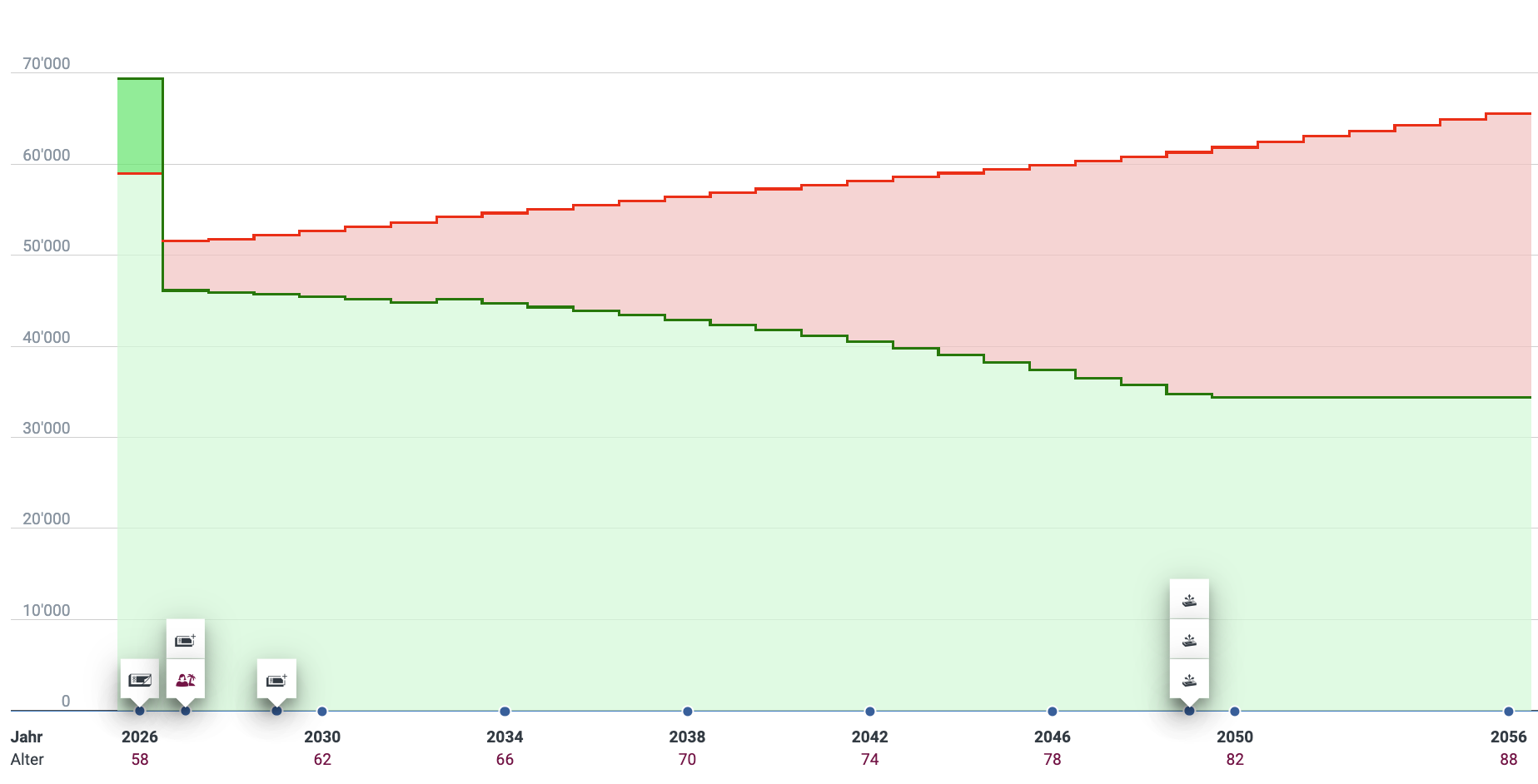
Graphic 1. Income and expenses until the statistical life expectancy. After exiting, the planned expenses (red line) permanently exceed the income (green line). The gap grows over the years. By 2050, the assets are depleted, no asset returns can be generated, and income stagnates. Expenses rise due to expected inflation.
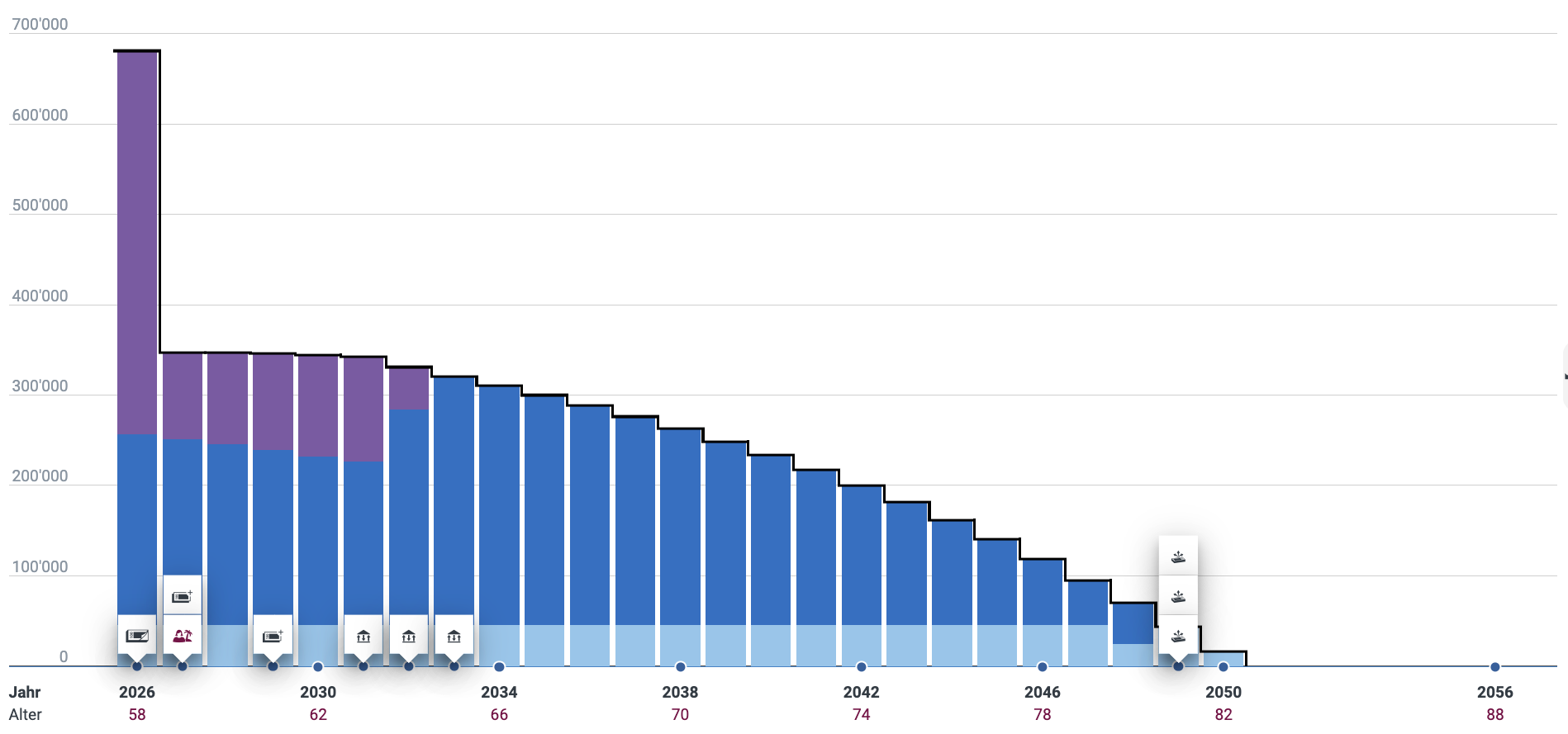
Graphic 2. Asset development. The purple area shows the tied pension savings. In 2026, it still includes the pension fund capital, which transitions into the ongoing pension in 2027. The remaining 3a assets are drawn in installments over three years. The annual gap between income and expenses is continuously covered from the assets. It decreases as planned but still barely lasts until a statistical life expectancy of 85 years.
The staggered withdrawal of the 3a accounts is not coincidental but planned. Capital benefits from pension savings are taxed separately from other income and at a reduced tax rate. However, all capital withdrawals made in the same year are aggregated. Those who dissolve the accounts over several years break the progression and save taxes (Art. 38 DBG, observe cantonal practice).
The calculation works out, but there is no reserve left. This is precisely where the value of the planned part-time salary becomes evident. Every franc earned preserves the assets and extends the reach of the financial plan. Interim earnings during the framework period have a double effect, as they supplement the daily allowance and demonstrate employability.
Why the choice can work in this case
On paper, immediate retirement is often the most expensive option. However, in this case, there are many reasons to believe that it is the right choice for three reasons:
Firstly, the client wants to continue working. Even those who are retired under the BVG can take on a new job. If the annual salary exceeds the entry threshold of currently CHF 22,680, she will be insured again with the pension fund of the new employer (Art. 2 and 7 BVG).
Secondly, she can and wants to consume her assets – after all, that is what they are for.
Thirdly, she knows her numbers and understands what budget discipline means in everyday life.
Supplementary benefits are a safety net, not a plan
A clarification is important here: Supplementary benefits (EL) are only available with a claim to an AHV or IV pension (Art. 4 ELG). Those who retire at 58 cannot bridge the years until the reference age with EL.
Furthermore, since the EL reform, there is an asset threshold: Singles with more than CHF 100,000 in assets are not entitled to supplementary benefits, while for couples, the limit is CHF 200,000 (Art. 9a ELG). The safety net exists, but it is set low and only kicks in when the assets are largely depleted. Ideally, those who plan carefully do not rely on it at all.
Conclusion: Facts over gut feeling
A termination shortly before retirement is a turning point. What comes next is crucial. Those who know the options of the pension fund, align the social plan benefits with the chosen option, and plan liquidity over the entire life expectancy make decisions based on a solid foundation. In the end, it is not the seemingly safest option that is the best, but the one that fits one's own life and personal plans.
The article was created in collaboration between Aeberli Financial Planning & Coaching, represented by Manuel Aeberli and G+D Netcetera, represented by Markus Büchel.
Legal foundations and sources
Art. 47a BVG. Continuation of insurance after the completion of the 58th year of age upon termination of the employment relationship by the employer (SR 831.40, www.fedlex.admin.ch)
Art. 13 Abs. 2 and 3 BVG and Art. 1i Abs. 1 BVV 2. Pre-withdrawal of retirement benefits from age 63, regulatory retirement at the earliest from age 58 (SR 831.40 and SR 831.441.1)
Art. 2 Abs. 1bis FZG. Entitlement to vested benefits upon exit between the earliest possible and normal retirement age (SR 831.42)
Art. 12 Abs. 1 FZV. Transfer of vested benefits to a maximum of two vested benefits institutions (SR 831.425)
Art. 8, 11a, 18c and 24 AVIG. Eligibility requirements, voluntary employer contributions, deduction of retirement benefits, interim earnings (SR 837.0)
Art. 10b and 12 AVIV. Accounting for voluntary employer contributions to occupational pension schemes, contribution period for early retirees (SR 837.02)
Art. 4 and 9a ELG. Eligibility requirements and asset threshold for supplementary benefits (SR 831.30)
Art. 335h ff. OR. Social plan (SR 220)
Art. 38 DBG. Separate taxation of capital benefits from pension savings at a reduced rate (SR 642.11)
BSV, Communications on occupational pensions No. 152 and 153. Implementation questions regarding Art. 47a BVG (sozialversicherungen.admin.ch)
SECO, AVIG practice ALE (www.arbeit.swiss)
Information Office AHV/IV, Information Sheet 5.01 Supplementary Benefits for AHV and IV (www.ahv-iv.ch)