Tax Progression in Switzerland Explained Simply
In Switzerland, the tax rate significantly determines how heavily your income is taxed. A progressive system ensures that higher incomes incur proportionally more taxes. While the average tax rate reflects the total tax share across income, the marginal tax rate shows how much is applied to the last franc earned.
The goal of this structure is a fair distribution of the tax burden, ensuring that individuals with higher earnings contribute appropriately without disproportionately burdening those at the lower end of the income spectrum.
https://tria-consulting.ch/steuern/
Tax Burden in Relation to Income
The income tax in Switzerland increases in steps, not linearly, meaning that additional income is not immediately taxed at the highest rate. Each new franc is taxed only at the respective progressive level, keeping the average burden always below the top tax rate.
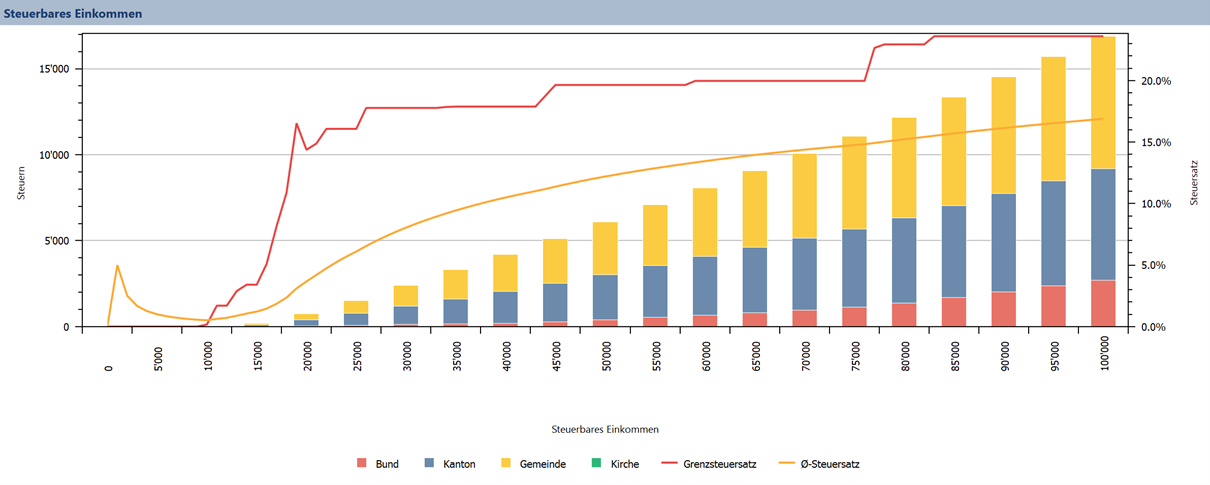
Higher incomes therefore experience an increasing burden without the entire amount being taxed at the maximum rate. This tiered approach allows for a balanced distribution of the tax burden, protecting lower incomes from disproportionate deductions and giving you room to strategically optimize your pension and investments.
Is there a uniform tax rate for everyone?
In Switzerland, there is no progressive tax system with a uniform rate like a flat tax. Instead, rates vary significantly depending on the canton and municipality, resulting in individual differences in total tax burden. Federal, cantonal, and municipal taxes add up to a total that depends on your place of residence, income, and personal deductions.
This means that two individuals with identical incomes can be taxed differently. The tiered progression ensures that higher incomes contribute more to the financing of public tasks. Those who inform themselves early about the cantonal differences and plan targeted pension contributions (such as into pillar 3a or occupational pension) can manage their tax burden efficiently.
Enormous Differences in Income Taxes
The income tax in Switzerland is subject to significant regional fluctuations, as each canton sets its own rates and deductions. While progression ensures that higher incomes are taxed more heavily, the amount of effective tax can vary significantly depending on your place of residence.
Your residence often determines how much of your income is effectively taxed. Cantons with low rates tax even relatively high incomes moderately, while other regions demand significantly higher contributions.
Mitigating Tax Progression through Deductions
In Switzerland, tax classes offer numerous opportunities to reduce progression through targeted deductions. Professional expenses, insurance premiums, and childcare costs can decrease taxable income and thus lower the tax burden.
Contributions to pillar 3a are particularly effective, as they directly reduce taxable income. Additionally, subsequent contributions to pillar 3a can serve as a tax-saving tip, especially when income rises temporarily or other deductions have been exhausted.
https://tria-consulting.ch/saeule-3aeinzahlen/
Calculating Income and Wealth Taxes
The calculation of taxes in Switzerland is based on taxable income. Income forms the basis for income tax after all allowable deductions have been considered, including professional expenses, insurance, and contributions to pillar 3a.
Wealth, on the other hand, is taxed separately at the cantonal level, with each canton setting its own exemptions and rates. The combination of income and wealth taxes determines your effective tax burden. Careful planning, targeted deductions, and optimizing pension contributions allow you to mitigate progression and reduce the tax burden.
What to Watch Out For
The tax progression in Switzerland can seem complex, but expert advice uncovers individual savings potentials and shows how you can optimize your tax burden in the long term. A targeted analysis of your income, deductions, and pension contributions helps effectively mitigate progression.
At Tria Consulting AG, the first consultation is free, allowing you to explore which measures are sensible for your personal situation without obligation. Through long-term planning, not only can you save taxes, but you can also optimally coordinate investments and pension contributions. Tria Consulting supports you in strategically managing your tax burden and efficiently shaping your financial future.
https://tria-consulting.ch/kontakt/