Collective or Joint Pension Foundation: What Does It Mean for My Retirement?
Published on 2026-11-17 · by Nico Fiore
Anyone who works and meets the statutory requirements must be insured with a pension fund. For SMEs, this is usually handled through what are known as collective or joint institutions. But what is the difference? And does the organisational form affect how much pension you will receive later on? A look behind the scenes of occupational pension provision shows what really matters.
Two organisational forms, one common goal
If you work for an SME, there is a good chance that your employer does not run its own pension institution (commonly referred to as a pension fund). Instead, it has joined a collective institution or a joint institution. Both allow several employers to insure their employees together in the second pillar. The difference lies primarily in the organisation and has little impact on you as an insured person.
A collective institution (often also called a collective foundation) brings several employers together under one roof, usually in the legal form of a foundation. The individual companies generally form their own pension plans with separate accounts. These may provide for different benefits, contributions or investment strategies. The financial performance is also often assessed separately for each pension plan.
A joint institution (joint foundation) likewise insures several employers and is also usually organised as a foundation. As the name suggests, however, a more collective organisation is typical here. The affiliated companies and their insured persons form one large community of insured persons, within which financial developments and risks are borne jointly.
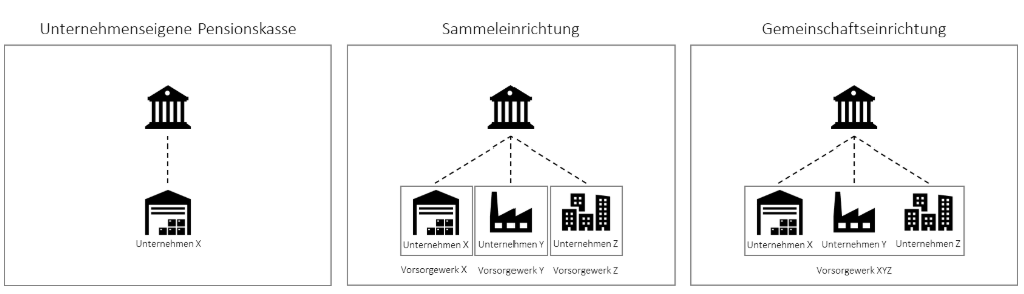
However, the boundaries between the two models are not always clear-cut. In practice, there are various forms and hybrid models. The name alone therefore says little about how your pension fund actually works.
For your retirement, how the pension fund is organised matters less than what benefits your pension plan offers and how financially sound the institution is.
What does this mean for my future pension?
The organisational form can influence how a pension institution distributes its risks and determines its benefits. However, it does not directly indicate whether you will receive a higher or lower pension later on. Three factors in particular are decisive.
The interest paid on your retirement savings
Your retirement savings are made up of your contributions, your employer's contributions and the interest credited. The higher the interest over the years, the more your savings grow.
How much interest is credited depends, among other things, on investment performance, the financial situation of the pension institution and its reserves. In a collective institution, the interest rate may differ from one pension plan to another. In a joint institution, it is normally set uniformly for the entire community of insured persons.
The conversion rate
The amount of your pension depends first and foremost on how much retirement savings you have accumulated by the time you retire. The conversion rate then determines what proportion of this capital is paid out each year as a pension. For example, with retirement savings of CHF 500,000 and a conversion rate of 5 per cent, the annual pension amounts to CHF 25,000.
The conversion rate is thus, in a sense, the factor by which the available capital is converted into a pension. However, it should not be considered in isolation: a higher conversion rate is of little use if the accumulated retirement savings are correspondingly lower. What ultimately matters is the interplay between savings contributions, interest, investment performance and the conversion rate.
The pension institution sets the conversion rate within the framework of the statutory requirements and its financial means. Factors such as life expectancy and expected investment returns play a role. The organisational form alone says nothing about its level.
Financial stability
Another important key figure is the funding ratio. It shows the extent to which a pension fund's liabilities are covered by its assets. A funding ratio of 100 per cent means that the available assets correspond to the calculated liabilities. If it is higher, the pension institution has reserves; if it is lower, there is what is known as underfunding.
Pension institutions are required by law to build up financial reserves. These serve as a safety cushion to absorb losses on the financial markets and to smooth out fluctuations. For insured persons, this means greater security: even if investments temporarily lose value, the reserves help to secure the promised benefits over the long term.
Can my employer change pension fund?
Yes. In principle, a company can decide to join a different pension institution in future. However, such a change also affects employees and must therefore take place with the involvement of the entire workforce or, in larger companies, with the involvement of a duly authorised employee representation, and in accordance with the statutory and regulatory requirements.
For you, a change does not mean that you lose the entitlements you have acquired so far. Your accumulated retirement savings are generally transferred to the new pension institution. However, the terms of your pension plan may change – for example with regard to contributions, insured risk benefits or options at retirement.
A change of pension fund is therefore more than an administrative decision. It can have a direct impact on your future pension benefits. When a change occurs, don't just look at the name or the organisational form of the new pension fund. Check what benefits the new pension plan offers and how it compares with the previous solution.
What you should look out for
To better assess your occupational pension provision, it is worth regularly reviewing your personal pension certificate. Among other things, it shows your current retirement savings, the insured benefits in the event of disability and death, and a projection of your expected retirement pension.
It is important to consider your occupational pension in the context of your overall financial situation. This includes, for example, your AHV pension, any other income, savings, securities, residential property and existing liabilities. Someone who owns their home and has only low housing costs in retirement, for instance, will assess their financial position differently from someone who still has to pay rent. Independent financial planning can help bring these factors together and weigh up the various options for retirement.
What matters is not a single key figure or the organisational form of your pension fund, but how well your occupational pension provision fits your personal life and financial situation. The various pension models offer different structures and options. It is therefore worth knowing your own benefits and considering them within the overall picture of your personal retirement provision.

About the author: Nico Fiore is Managing Director of the pension fund association inter-pension.
In this role, he represents the interests of collective and joint institutions vis-à-vis politicians, authorities and the public. His areas of focus are occupational pension provision (BVG), retirement provision, public affairs and association management.
He holds a Swiss Federal Diploma of Higher Education in Pension Fund Management and an MAS in Pension Fund Management from Lucerne University of Applied Sciences and Arts. He has headed the inter-pension office since September 2023.